
You land in Costa Rica with one goal: get wet early, surf a lot, and feel noticeably better by the time you fly home. The problem is that a surf trip can turn into a logistics project fast – finding the right beach for your level, matching tides, sorting boards, getting to the best breaks, and still having energy left to enjoy the place.
That’s exactly why surf camp packages Costa Rica are so popular. They’re built to remove friction. But not all packages are the same, and the details matter more than the marketing photos. Below is what a good package really includes, how to match it to your level, and where the trade-offs tend to hide.
What “surf camp packages” usually include (and what they should)
At a minimum, a surf camp package is a bundle: accommodations plus surf. The better ones go further and build a full system around your time in the water.
A strong package includes lodging close to the beach, daily surf instruction or guided sessions, and easy access to the right surfboard for the conditions. That last part is bigger than people think. A board that’s wrong for your weight or the wave size can stall progression for days.
You’ll also see airport transfers included in many premium options. In Costa Rica, that is not just a convenience perk. It’s a time-and-stress saver, especially if you’re flying into Liberia and heading to the Guanacaste coast. When your ride is coordinated, you’re not negotiating with taxis, figuring out car rentals, or dealing with late-night arrivals.
Meals vary. Some camps include breakfast only, others include all meals, and some do a hybrid. Here’s the honest trade-off: all meals can be great if you want a fully hosted experience, but breakfast-only often fits travelers who want flexibility to explore local restaurants at lunch and dinner.
The real value is the coaching system, not the bundle
Two camps can offer “daily lessons,” yet deliver totally different outcomes.
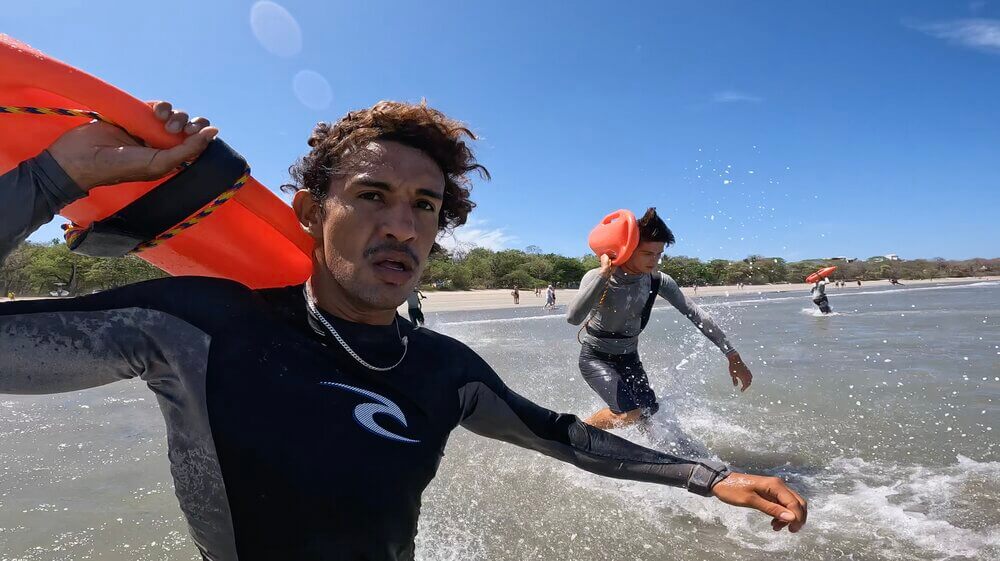
If you’re a beginner, you need more than someone pushing you into whitewater. You need safety, etiquette, ocean awareness, and a step-by-step plan that gets you to clean green waves at the right moment. That means reading peaks, learning where to paddle out, timing sets, and understanding currents – not just standing up.
If you’re intermediate, the biggest bottleneck is usually decision-making and technique under pressure: where you sit, when you go, how you angle takeoffs, and how you manage speed once you’re up. This is where video coaching becomes a game changer. Seeing yourself surf – and getting clear feedback – compresses months of trial and error into a few days.
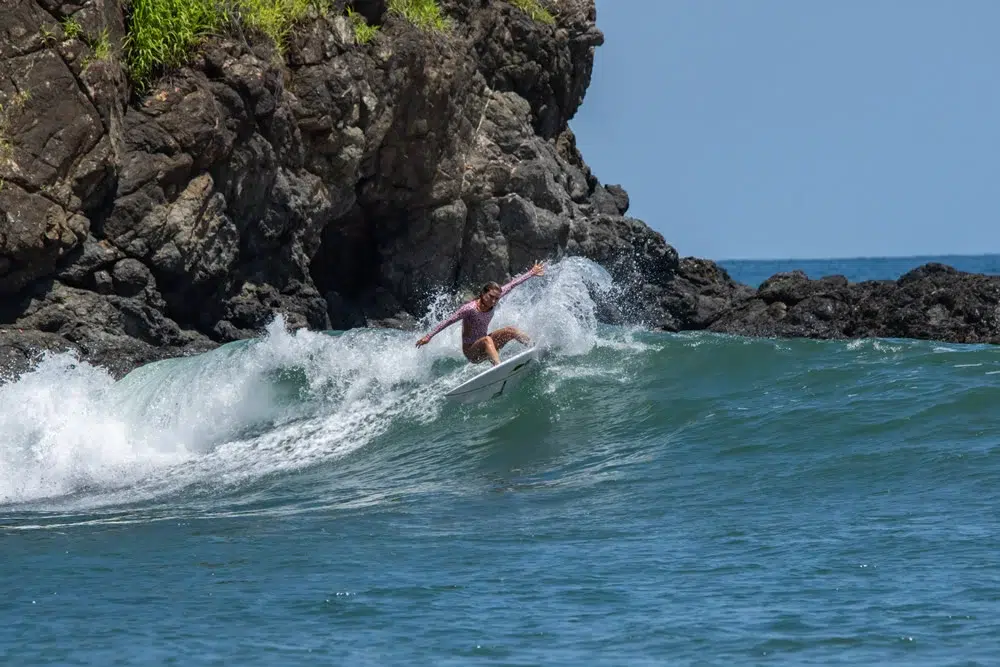
Advanced surfers don’t need someone to tell them to pop up. They need efficient wave-hunting: local knowledge that puts them on the best break for the swell direction, tide, and wind, with a plan to maximize quality waves in limited time.
A well-run camp program has a ladder. Beginners aren’t mixed into lineups they shouldn’t be in. Intermediates aren’t stuck doing the same warm-up drills every day. Advanced surfers aren’t wasting prime conditions at the wrong spot.
Surf camp packages Costa Rica by surfer level
Choosing the right package is mostly about being honest about where you are right now, not where you wish you were.
If you’re a beginner: look for safety, structure, and the right wave
Beginners progress fastest in consistent, forgiving waves with a sandy bottom and a lineup that doesn’t feel intimidating. The package should emphasize fundamentals: paddling technique, pop-up mechanics, stance, trimming, and simple turns – plus ocean knowledge and etiquette.
A good beginner schedule has repetition and coaching feedback baked in. You want instructors watching you closely, giving corrections in the moment, and setting you up in the right spot to succeed. Unlimited board access matters here because beginners often need more volume than they expect, and different shapes can make learning dramatically easier.
The trade-off: if you choose a “beginner-friendly” package that’s also trying to satisfy every level at once, you may get watered-down instruction. It’s worth picking a camp that clearly states how beginner coaching is organized and what “success” looks like by the end of the week.
If you’re intermediate: prioritize video analysis and guided spot choice
Intermediates often have the fitness and the stoke, but they’re stuck in patterns: late drops, going straight, losing speed, or getting caught inside. The fastest fix is targeted coaching paired with reps in the right conditions.
This is where guided sessions matter. A coach who chooses the spot based on swell, tide, and wind will put you in waves that let you practice the exact skill you’re working on, whether that’s cleaner takeoffs, better positioning, or turning with control.
Video review is the multiplier. It’s one thing to feel like you’re compressing or rotating. It’s another to see it and get a clear correction for the next session.
The trade-off: intermediate surfers sometimes book a package that’s too “tour” focused. Exploring is fun, but if your goal is a step-change in surfing, you want a program that balances adventure with deliberate practice.
If you’re advanced: look for access, timing, and local decision-making
Advanced surfers don’t need a pep talk. They need waves. In Costa Rica, that often means a base near consistent surf plus the ability to strike when conditions line up at more demanding breaks.
A strong advanced package includes guiding that’s responsive, not rigid. If the wind swings offshore at a certain spot, you go. If the tide is wrong, you pivot. If the swell fades, you adjust expectations and hunt what still works.
The trade-off: some “advanced” packages oversell access to marquee waves but don’t deliver the daily decision-making that gets you there at the right time. Ask how spot selection works, how often they run trips, and what happens when conditions change.
What a typical day should feel like
The best surf camp days have rhythm. You wake up close to the beach, eat breakfast without rushing, and have a clear plan before you wax a board.
A quality operation will brief the day like a coach, not a tour guide. Where are you surfing, why is it the right call today, what are you focusing on, and what should you watch for in the water? That clarity reduces anxiety for beginners and saves time for experienced surfers.
After the session, you want time to recover, review footage or feedback, and reset. Some people underestimate how physical surfing multiple days in a row can be, especially if you’re adding paddling volume and learning new movement patterns. A good camp bakes in enough downtime so you can surf hard again tomorrow.
Questions to ask before you book
Most disappointments come from assumptions. A quick set of questions can prevent that.
Ask what’s actually included: number of nights (many programs have a minimum), whether lessons are daily, whether boards are unlimited, and if airport transfers are private or shared. Clarify how groups are organized by level and how many surfers per coach. Also ask what happens if conditions are small, windy, or rainy – do they pivot to different breaks, adjust lesson formats, or add theory and video work?
If you care about progression, ask how they measure it. A camp that can describe their curriculum clearly is usually a camp that runs a real program.
Why Tamarindo and Guanacaste are a sweet spot for packages
Costa Rica has great surf zones, but Guanacaste stands out for travelers who want consistency and options. You can often find manageable waves close to shore, with the ability to drive or boat to higher-performance spots when conditions are right.
That mix matters because it keeps the trip productive for different levels and different swell days. It also makes the vacation part easier – restaurants, walkability, and a beach-town vibe that doesn’t require an expedition plan.
A proven example of the all-inclusive model
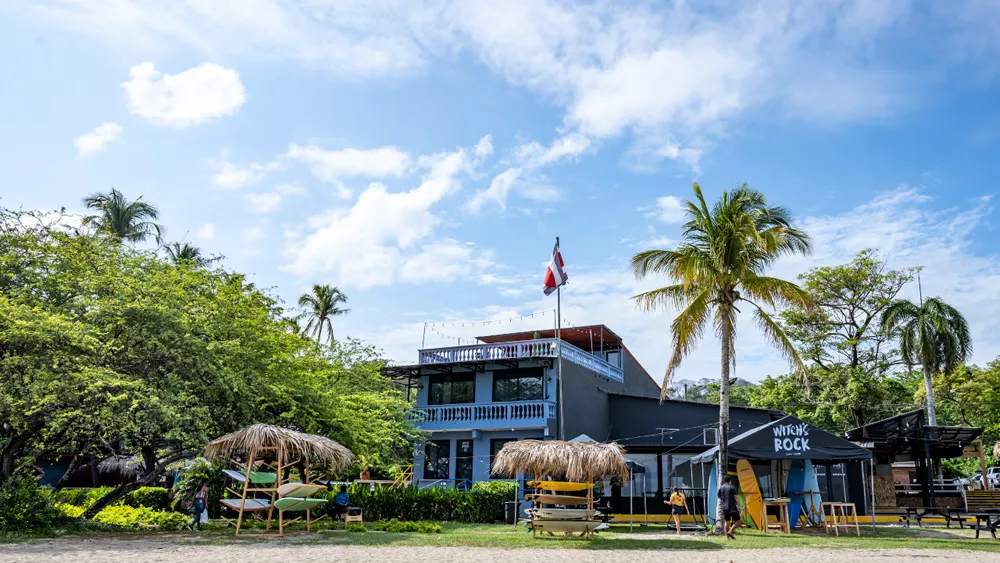
If you want the classic turnkey experience – beachfront base, structured coaching, a serious board quiver, and logistics handled from the moment you land – Witch’s Rock Surf Camp in Tamarindo is built around that exact promise, with a long track record since 2001 and a program designed for beginners through advanced surfers.
The best way to choose a surf camp package in Costa Rica is to pick the version of the trip you actually want: more coaching or more roaming, more structure or more freedom, more convenience or more DIY. Get that decision right, and everything else gets easier – including the surfing.